
Native Species Resolver
The Native Species Resolver (NSR) uses a database of regional taxonomic checklists to determine whether observations of a species within political divisions (country, state/province, county/parish, etc.) are native or introduced. The decision that species X is introduced in political division Y can be based on one or more of three criteria:
- Presence in a checklist for region Y, with a status of “introduced”;
- Absence from a comprehensive list of species native to region Y;
- Endemism in (restriction to) a region other than region Y.
Examples and vignette: NSR vignette.
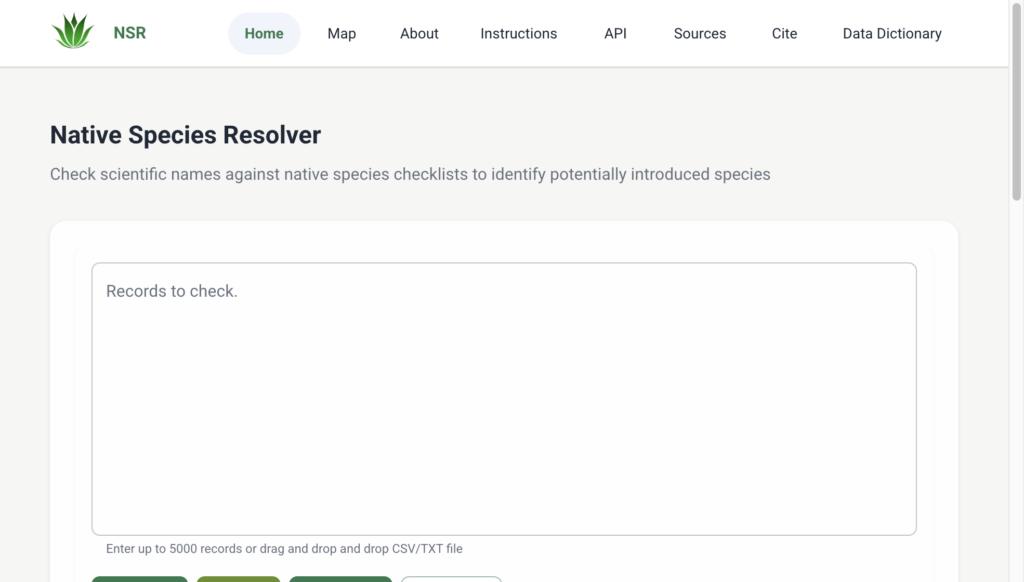
Input
The NSR accepts one or more “observations” of a species (Latin binomial or trinomial, without the authority) in a country, a country + state/province, or a country + state/province + county/parish. How these observations are formatted depends on how you access the NSR (batch mode, web service, or web user interface; see NSR interfaces below).
Output
For each observation submitted, the NSR returns an opinion as to whether the observed species is native or introduced in the political unit of observation. For more details, see the NSR data dictionary.
NSR data sources
The NSR currently uses comprehensive checklists for Canada, the United States, Ecuador, Peru and Bolivia, supplemented by lists of introduced species in the eastern United States and taxa endemic to the Old World. We need more data! Please contact us with links to additional checklists. For more information, see NSR data sources.
NSR interfaces
- NSR web interface — for non-programmers.
- NSR batch mode (shell access required).
- NSR API — programmatic access.
- RNSR R package — from within R.