Skip to content
  • Overview
  • Data & Access
    • Data summary
    • Data & Access
    • Citation & how to cite
  • Methods & Workflow
    • Tutorial: BIEN Flags and Data Augmentation
  • Tools & Services
    • TNRS
    • GNRS
    • GVS
    • NSR
    • All applications & tools
  • About
    • About BIEN
    • Participants
    • Data contributors
    • Acknowledgments
    • Links
Botanical Information and Ecology Network

Botanical Information and Ecology Network

Menu

Methods and Workflow

Methods & Workflow

How BIEN turns raw observations into analysis-ready data

BIEN combines occurrence, plot, trait, and range information through a documented, modular workflow built for transparency and reproducibility. Every record passes through four coordinated services — TNRS, GNRS, GVS, and NSR — each adding quality-control flags so results can be filtered explicitly and reproduced.


Historical color botanical illustration of a cactus (Cactaceae) from The Cactaceae by Britton and Rose, 1919-1923.
Britton & Rose, The Cactaceae (1919–1923). Public domain · Image credits

The big picture

An integrated, modular workflow

BIEN ingests diverse biodiversity observations from three primary sources — specimens (herbaria, museums, and citizen-science platforms), vegetation-plot surveys, and field trait measurements — and consolidates them into one standardized, analysis-ready framework. Counts and labels are outputs of specific query and validation pathways; interpretations should include dataset version, query constraints, and QA context.
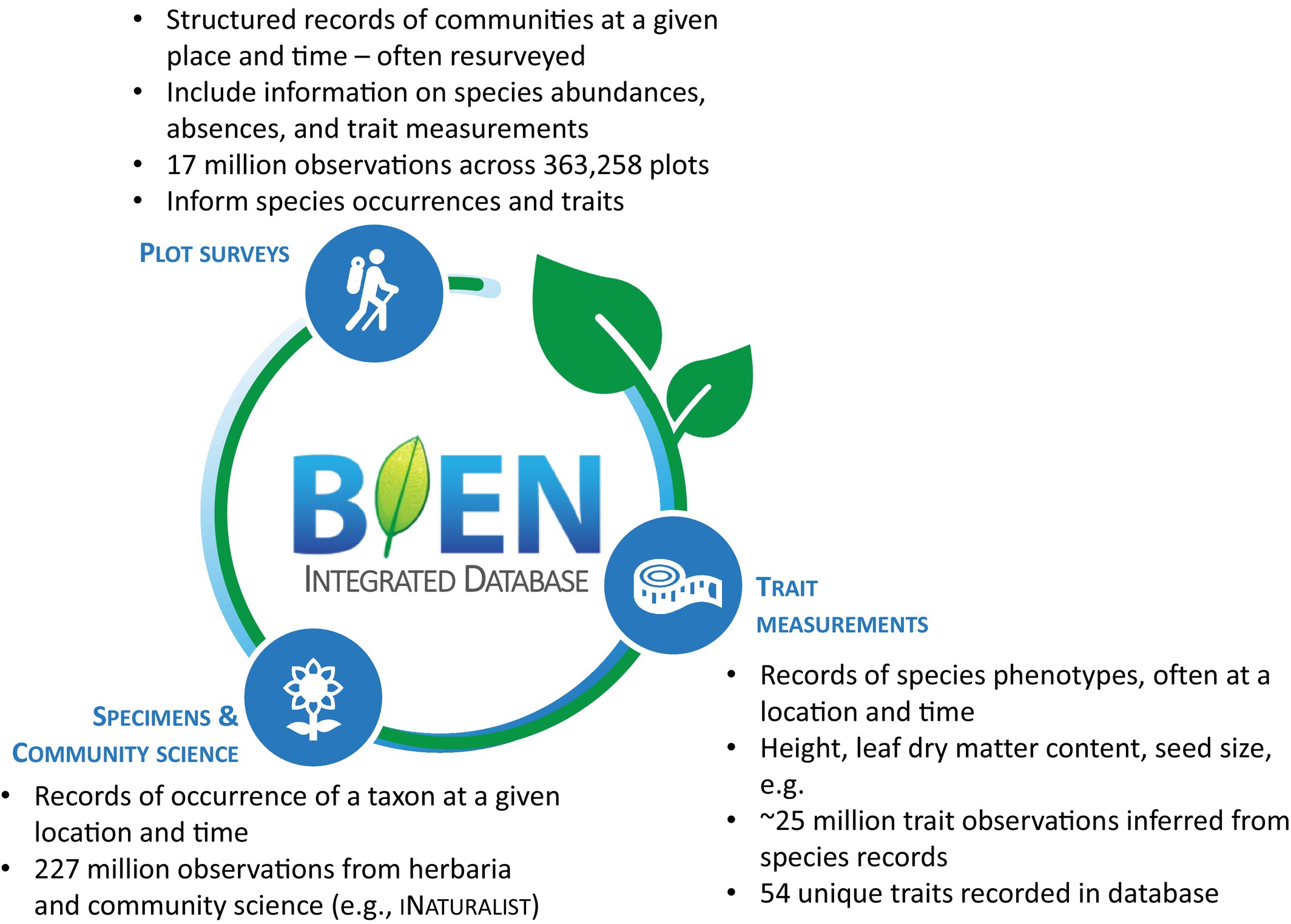
Figure 1 · The BIEN modular workflow

The BIEN modular workflow integrating three primary data sources - specimens, plot surveys, and trait measurements - into a unified, standardized framework.

A modular workflow integrating diverse observation data. BIEN consolidates specimens, plot surveys, and trait measurements into a unified framework — standardizing data, reducing biases, and enabling reproducible workflows across cross-scale ecological and evolutionary analyses. Source: Enquist et al. (2026), Methods in Ecology and Evolution 17(5), Fig. 1. CC BY-NC-ND 4.0.

The four core services

All records entering the workflow pass through four services, accessible via web apps, APIs, and R packages. Each augments records with flags you can use to filter and subset the data.


TNRS logo

TNRS
Taxonomic Name Resolution Service

Open service
R vignette

GNRS icon

GNRS
Geographic Name Resolution Service

Open service
R vignette

GVS logo

GVS
Geocoordinate Validation Service

Open service
R vignette

NSR logo

NSR
Native Species Resolver

Open service
R vignette

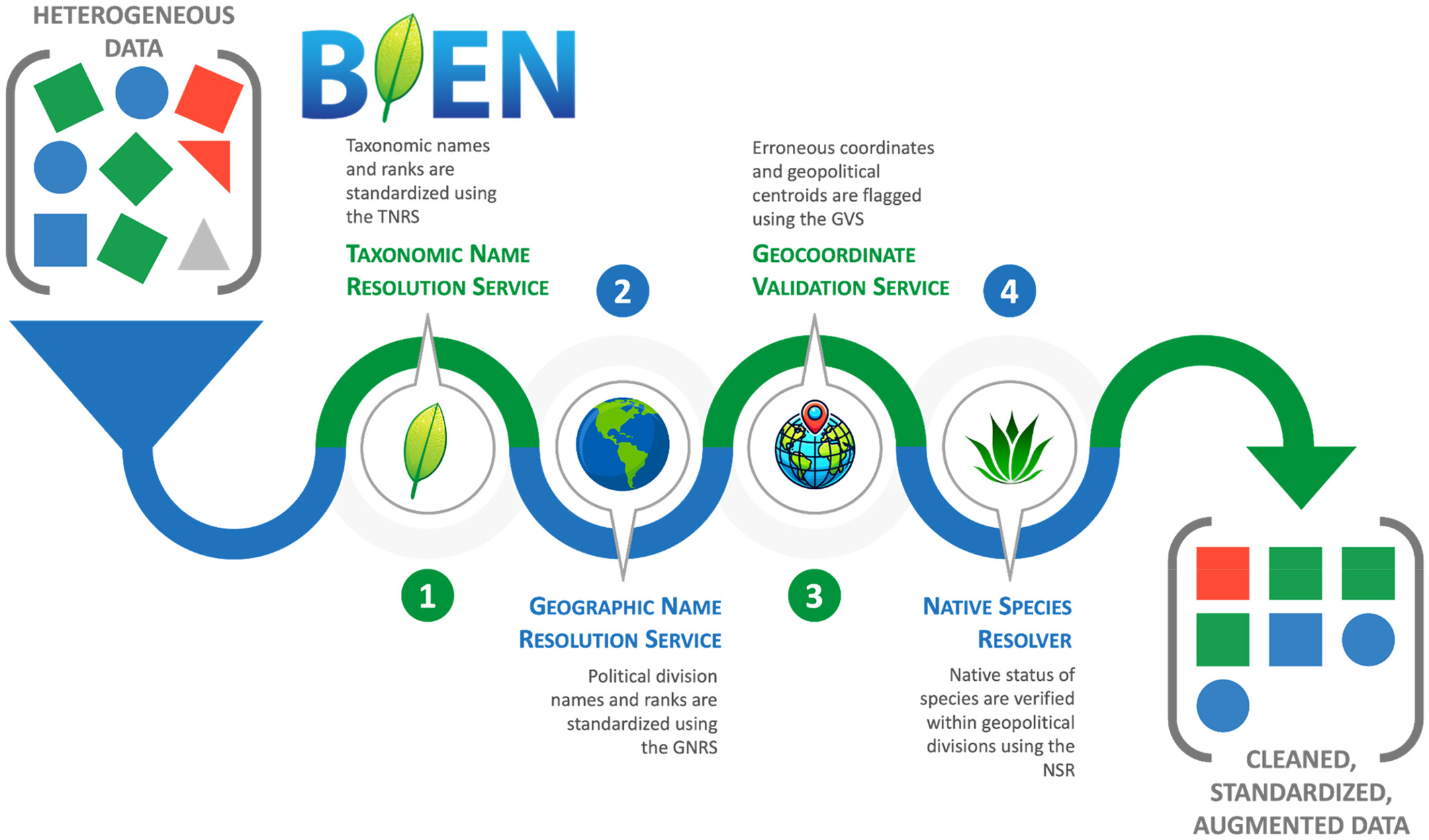
Figure 2 · The four core services

The four BIEN services: TNRS resolves taxonomic inconsistencies, GNRS standardizes geographic metadata, GVS validates coordinates, and NSR determines native and cultivated status.

Four services augment every record. (1) TNRS resolves taxonomic inconsistencies; (2) GNRS standardizes geographic metadata; (3) GVS flags spatial errors and validates coordinates; (4) NSR determines native and cultivated status. They operate together or independently, via APIs and the BIEN R package. Source: Enquist et al. (2026), Methods in Ecology and Evolution 17(5), Fig. 2. CC BY-NC-ND 4.0.

The validation sequence

The diagram below traces the four validation steps applied to every record as it becomes analysis-ready.
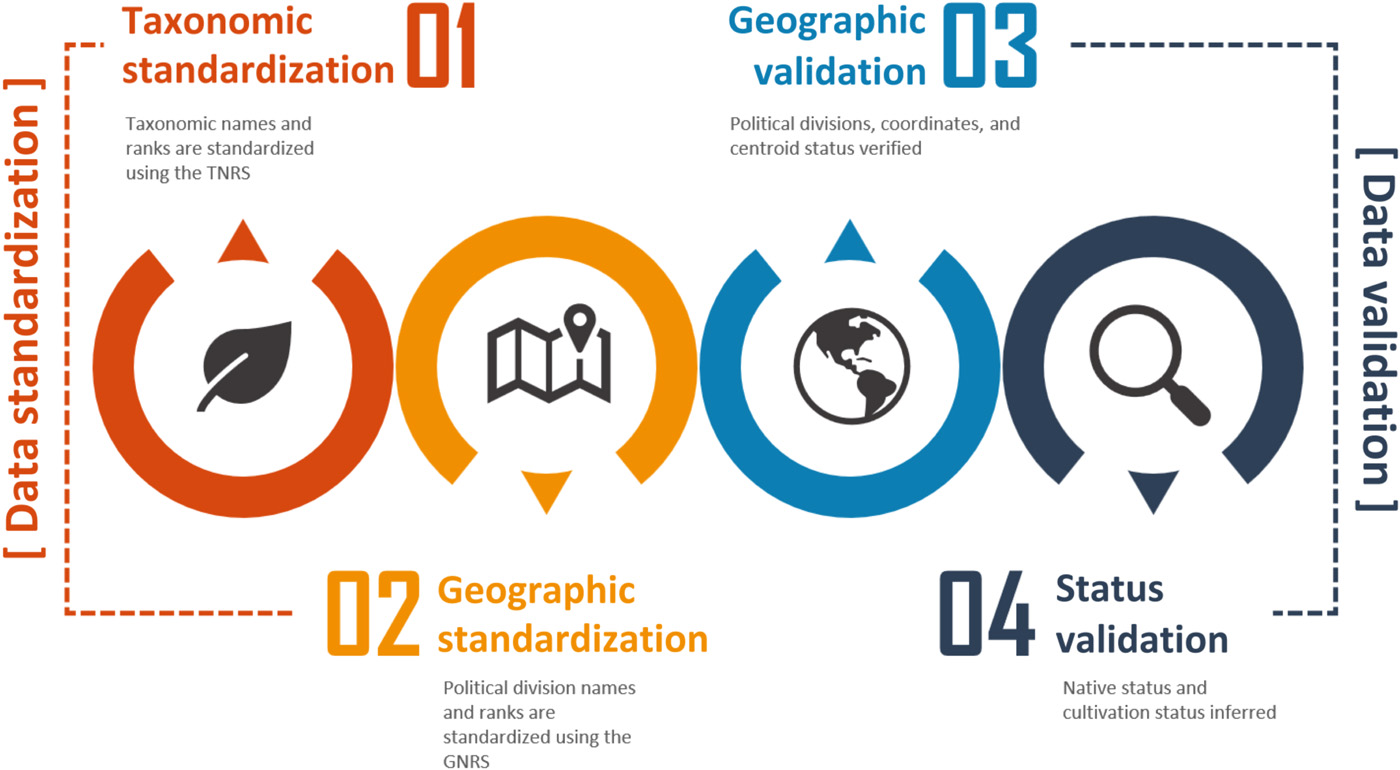
Workflow at a glance

BIEN computational workflow: taxonomic standardization with the TNRS, geographic standardization with the GNRS, geographic validation of coordinates and political divisions, and native-status validation.

Standardization and validation in four steps: (1) taxonomic standardization with the TNRS, (2) geographic standardization with the GNRS, (3) geographic validation of coordinates and political divisions, and (4) status validation inferring native and cultivation status. Figure reproduced from Enquist et al. (2019), “The commonness of rarity,” Science Advances 5(11):eaaz0414, doi.org/10.1126/sciadv.aaz0414 (open access, CC BY-NC).

Workflow sequence

  1. Ingestion and source harmonization
  2. Taxonomic reconciliation (TNRS)
  3. Geographic name and coordinate validation (GNRS, GVS)
  4. Native-status resolution and integration (NSR)
  5. Versioned export for analysis-ready products

Related BIEN package links

  • BIEN on CRAN — R package and vignettes.
  • TNRS vignette — package workflow and examples.
  • GNRS vignette — package workflow and examples.
  • GVS vignette — package workflow and examples.
  • NSR vignette — package workflow and examples.

Citation: Enquist BJ, Boyle B, Maitner BS, et al. (2026). BIEN: A biodiversity informatics ecosystem advancing open and reproducible workflows for plant observation, plot and trait data. Methods in Ecology and Evolution, 17(5), 1556–1584. DOI: 10.1111/2041-210X.70274.

The BIEN network
  • About BIEN
  • Methods and Workflow
  • Participants
  • Data contributors
  • Projects
  • Meetings
  • Publications
  • Acknowledgments
  • Links
Archive
  • Archive and legacy BIEN
  • Previous BIEN versions
  • SALVIAS
More
  • News
  • Contributor login
BIEN database version: 4.2

Search

Recent Posts

  • News

Botanical Information and Ecology Network 2026 . Powered by WordPress